


New results on the history of horse domestication were published in the current issue of Acta Archaeologica Hungaricae in late 2025. The results confirm that an early horse lineage—widespread prior to the emergence of modern domestic horses—survived into the Middle Bronze Age in the Carpathian Basin. The study was conducted as part of a joint research programme of the ELTE RCH Institute of Archaeogenomics and the MTA–ELTE RCH Momentum BASES Research Group, which investigates the history of horses in the 3rd and 2nd millennia BCE.
Horse domestication is one of the key elements of human history due to its impact on warfare, trade, and economy. Horsekeeping and their utilisation first began from the mid-4th millennium BCE on the Asian steppe; however, according to archaeogenomic data (Gaunitz et al. 2018; Librado et al. 2021), the ancestors of modern horses only spread across Eurasia from the very end of the 3rd millennium BCE onward. In the Carpathian Basin, this process is clearly demonstrated—alongside the latest genetic results (Librado et al. 2024)—by the appearance of antler cheekpieces in Bronze Age settlements (Bozi–Szabó 2022; Kanne 2025).
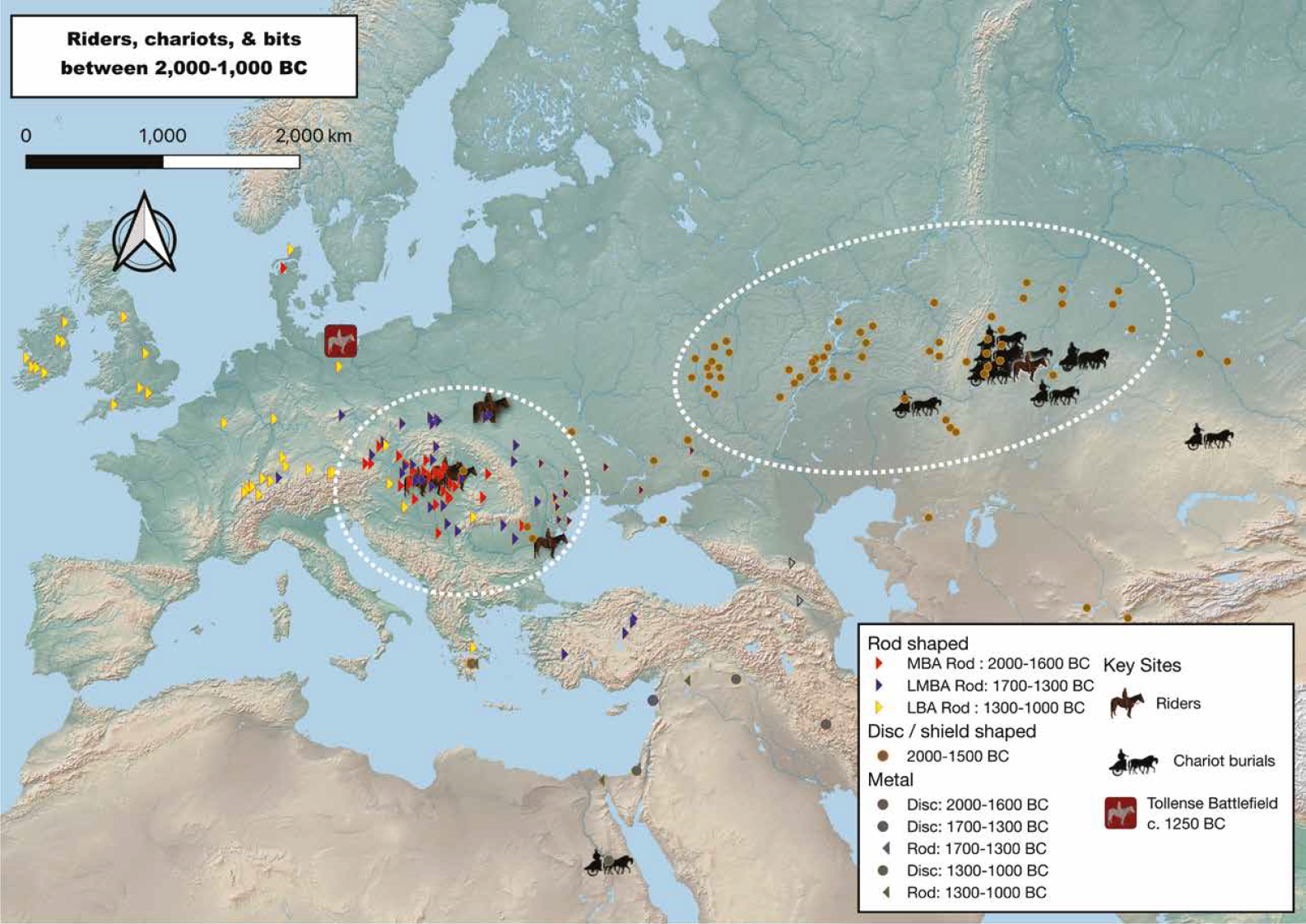 Bits and Bridle Circles, Riders, and Chariot Burials in Eurasia 2,000–1,000 BCE (Kanne 2025, Fig. 7).
Previous archaeogenomic studies (Gaunitz et al. 2018; Librado et al. 2021) have shown that earlier, sporadic domestication attempts targeted now extinct or Przewalskii horse related lineages. However, it remains poorly understood, how these earlier, wild lineages declined and ultimately went extinct during the few centuries long transformation process, and why they left almost no genetic legacy to modern breeds.
To address these questions, in our paper, published in the latest issue of Acta Archaeologica Hungaricae (76/2 [2025]), we report a new horse genome, obtained from a skull recovered from the Tompa archaeological site in southern Hungary. The remains were found along with ceramics of the Middle Bronze Age Vatya culture, and radiocarbon dated between 1870 and 1620 BCE (Bozi–Szabó 2022). Genetic analysis of the skull indicates that the individual belonged to a (wild) horse lineage native to the region, demonstrating 200–300 years greater survival, compared to previous estimates. Moreover, in conjunction with archaeozoological results, this finding provides the first direct evidence for keeping a non-domestic related lineage in the region, along with the ancestors of modern-day domestic horses.
In this light, it is an unexpected discovery that neither modern domestic horses—except for the tarpan breed, which became extinct 100 years ago—nor the Tompa horse, possibly one of the last representatives of its lineage, shows any sign of admixture between the two groups. This observation points to an artificial control on the prevailing lineages or, perhaps, an as-yet unknown natural phenomenon may have played a role. Nevertheless, prior to their extinction, the population size of this lineage shows the sign of a steady decline, indicating a long-term process driven by human and/or environmental factors rather than a rapid event. These results may serve as the foundation for future studies to gain further insight into human–horse interaction in the region.
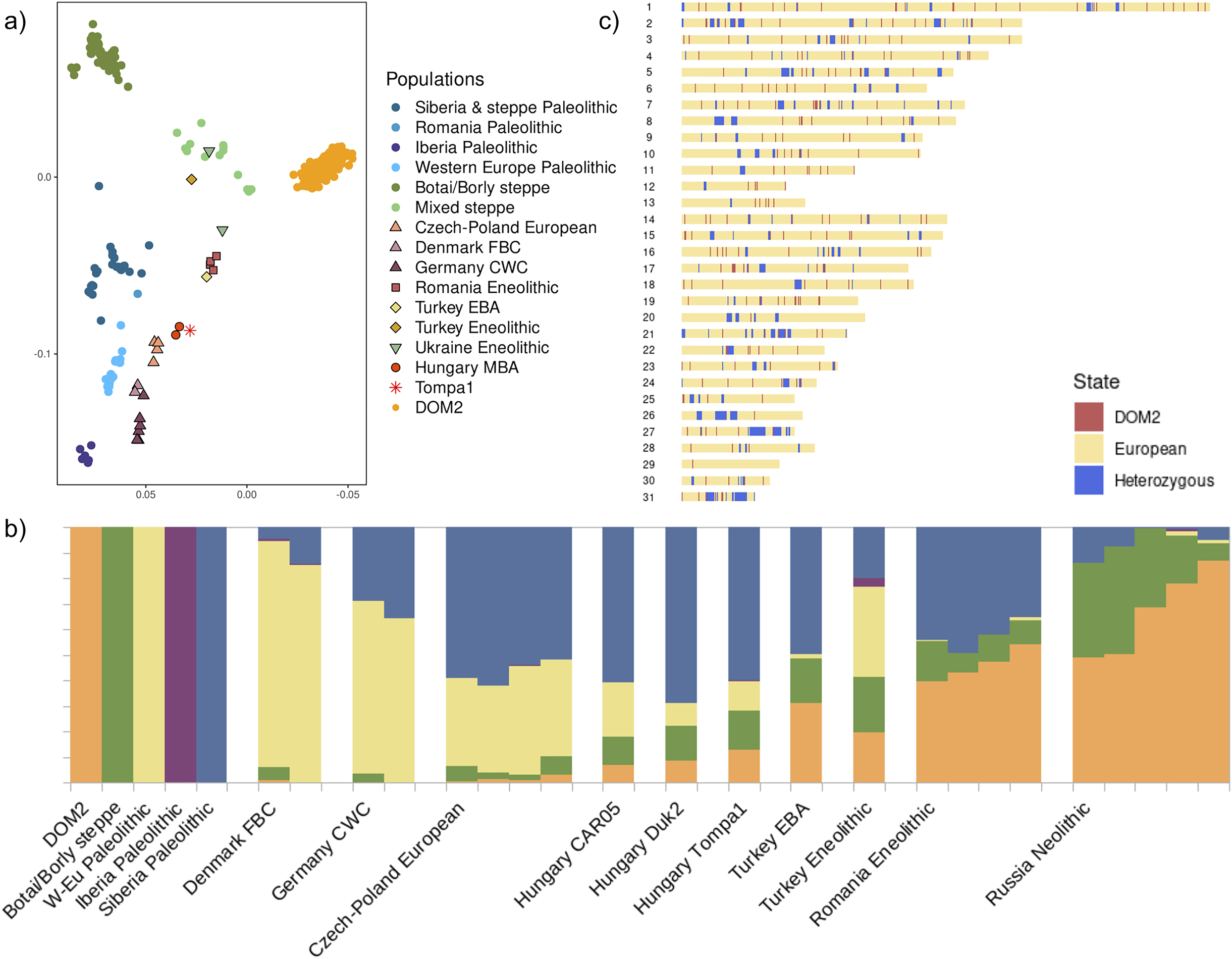 Genomic composition of ancient horses. (a) Principal component analysis of horse genomes (each symbol represents one horse, while different colours and shapes indicate different groups). In addition to the two modern ones (domestic horses shown in orange and Prezwalskii horses in dark green), several extinct lineages are also represented; among these, prehistoric horses from Hungary (Hungary MBA and Tompa1) fit well within the genetic structure of the region. (b) STRUCT-f4 analysis provides a schematic overview of the genomic composition of the different samples. Each colour represents a genetic component inferred from the whole dataset, and their proportions (y-axis) indicate the composition of each sample (columns on the x-axis), and thus their genetic similarity to or divergence from other samples. The Tompa1 sample (based on this and further analyses) fits well into the genomic profiles of horses known from the region (e.g. Duk2, CAR05). (c) Distribution of DNA segments related to domestic horses (DOM2) on the chromosomes of Tompa1 (the individual analysed in this study). The size and distribution of DOM2-associated segments do not indicate recent admixture (Gerber et al. 2025, fig. 1).
Find the article here:
Dániel Gerber, Zoltán Dicső, Géza Szabó, Róbert Bozi, Botond Heltai, Gabriella Kulcsár, Balázs Gusztáv Mende, Viktória Kiss and Anna Szécsényi-Nagy: Extended pre-domestication horse lineage survival in the Carpathian Basin. Acta Archaeologica Academiae Scientiarum Hungaricae 76 (2025) 2, 251–262. DOI: 10.1556/072.2025.00036
Cover image: Mongolian wild horse. Source: Wikimedia Commons / CC-BY-SA-4.0
Bibliography
Bozi, R. and Szabó, G. (2022). The beginnings of the use of equids as work animals in the Bronze Age Carpathian Basin. Anteus, 38: 107–142. https://real.mtak.hu/175812/
Gaunitz, C., Fages, A., Hanghøj, K., Albrechtsen, A., Khan, N., Schubert, M., Seguin-Orlando, A., Owens, I.J., Felkel, S., Bignon-Lau, O., de Barros Damgaard, P., Mittnik, A., Mohaseb, A.F., Davoudi, H., Alquraishi, S., Alfarhan, A.H., Al-Rasheid, K.A.S., Crubézy, E., Benecke, N., Olsen, S., Brown, D., Anthony, D., Massy, K., Pitulko, V., Kasparov, A., Brem, G., Hofreiter, M., Mukhtarova, G., Baimukhanov, N., Lõugas, L., Onar, V., Stockhammer, P.W., Krause, J., Boldgiv, B., Undrakhbold, S., Erdenebaatar, D., Lepetz, S., Mashkour, M., Ludwig, A., Wallner, B., Merz, V., Merz, I., Zaibert, V., Willerslev, E., Librado, P., Outram, A.K., and Orlando, L. (2018). Ancient genomes revisit the ancestry of domestic and Przewalski’s horses. Science, 360: 111–114, https://doi.org/10.1126/
Kanne, K. (2025). Horse domestication and early use. In: Benkert, H. and Kanne, K. (Eds.), Harnessing horses from Prehistory to history. Approaches and case studies. Leiden, pp. 97–122. https://doi.org/10.59641/WW723ZI
Librado, P., Khan, N., Fages, A., Kusliy, M.A., Suchan, T., Tonasso-Calvière, L., Schiavinato, S., Alioglu, D., Fromentier, A., Perdereau, A., Aury, J.-M., Gaunitz, C., Chauvey, L., Seguin-Orlando, A., Der Sarkissian, C., Southon, J., Shapiro, B., Tishkin, A.A., Kovalev, A.A., Alquraishi, S., Alfarhan, A.H., Al-Rasheid, K.A.S., Seregély, T., Klassen, L., Iversen, R., Bignon-Lau, O., Bodu, P., Olive, M., Castel, J.-C., Boudadi-Maligne, M., Alvarez, N., Germonpré, M., Moskal-del Hoyo, M., Wilczynski, J., Pospuła, S., Lasota-Kus, A., Tunia, K., Nowak, M., Rannamäe, E., Saarma, U., Boeskorov, G., Lougas, L., Kysely, R., Peske, L., B˘al˘as¸escu, A., Dumitras¸cu, V., Dobrescu, R., Gerber, D., Kiss, V., Szécsényi-Nagy, A., Mende, B.G., Gallina, Z., Somogyi, K., Kulcsár, G., Gál, E., Bendrey, R., Allentoft, M.E., Sirbu, G., Dergachev, V., Shephard, H., Tomadini, N., Grouard, S., Kasparov, A., Basilyan, A.E., Anisimov, M.A., Nikolskiy, P.A., Pavlova, E.Y., Pitulko, V., Brem, G., Wallner, B., Schwall, C., Keller, M., Kitagawa, K., Bessudnov, A.N., Bessudnov, A., Taylor, W., Magail, J., Gantulga, J.-O., Bayarsaikhan, J., Erdenebaatar, D., Tabaldiev, K., Mijiddorj, E., Boldgiv, B., Tsagaan, T., Pruvost, M., Olsen, S., Makarewicz, C.A., Valenzuela Lamas, S., Albizuri Canadell, S., Nieto Espinet, A., Iborra, M.P., Lira Garrido, J., Rodríguez González, E., Celestino, S., Olària, C., Arsuaga, J.L., Kotova, N., Pryor, A., Crabtree, P., Zhumatayev, R., Toleubaev, A., Morgunova, N.L., Kuznetsova, T., Lordkipanize, D., Marzullo, M., Prato, O., Bagnasco Gianni, G., Tecchiati, U., Clavel, B., Lepetz, S., Davoudi, H.,Mashkour, M., Berezina, N.Ya., Stockhammer, P.W., Krause, J., Haak, W., Morales-Muñiz, A., Benecke, N., Hofreiter, M., Ludwig, A., Graphodatsky, A.S., Peters, J., Kiryushin, K.Yu., Iderkhangai, T.-O., Bokovenko, N.A., Vasiliev, S.K., Seregin, N.N., Chugunov, K.V., Plasteeva, N.A., Baryshnikov, G.F., Petrova, E., Sablin, M., Ananyevskaya, E., Logvin, A., Shevnina, I., Logvin, V., Kalieva, S., Loman, V., Kukushkin, I., Merz, I., Merz, V., Sakenov, S., Varfolomeyev, V., Usmanova, E., Zaibert, V., Arbuckle, B., Belinskiy, A.B., Kalmykov, A., Reinhold, S., Hansen, S., Yudin, A.I., Vybornov, A.A., Epimakhov, A., Berezina, N.S., Roslyakova, N., Kosintsev, P.A., Kuznetsov, P.F., Anthony, D., Kroonen, G.J., Kristiansen, K., Wincker, P., Outram, A., and Orlando, L. (2021). The origins and spread of domestic horses from the Western Eurasian steppes. Nature, 598: 634–640, https://doi.org/10.1038/s41586-021-04018-9


