


The political, demographic and cultural transformations that took place in Western Europe following the collapse of the Western Roman Empire between the 4th and 6th centuries CE have long been central questions in the study of this period. Yet surprisingly little is known about how these changes affected the communities living in the frontier regions of the former empire. A new study based on archaeogenomic and isotope analyses and archaeological finds paints a more nuanced picture of the organisation of early medieval communities in the Langobard-period Little Hungarian Plain (previously part of the Pannonian provinces of the Roman Empire), and how their connections could have served as a basis for the emerging new political systems. The study was conducted as part of the HistoGenes project, with an international team including colleagues of our institute. Their findings were published in Science.
Our international and multidisciplinary ERC HistoGenes research team and lead authors Yijie Tian (Stony Brook University, NY) and István Koncz (Eötvös Loránd University, Hungary) completed the comprehensive bioarchaeological analysis of two late Roman (3rd to 5th centuries CE) and five Langobard-period (6th century CE) cemeteries in the Little Hungarian Plain, an area in northwestern Hungary. More than 300 individuals were subjected to whole genome analysis, alongside isotope analyses of mobility (strontium) and diet (carbon and nitrogen), providing a clearer picture of the lives of individuals and the social processes that shaped their communities. Through the combined use of ancient DNA data and the archaeological record of funerary practices we reconstructed the social relations of the Little Hungarian Plain, an important territory of the former Roman province Pannonia, after the decline of Roman rule.
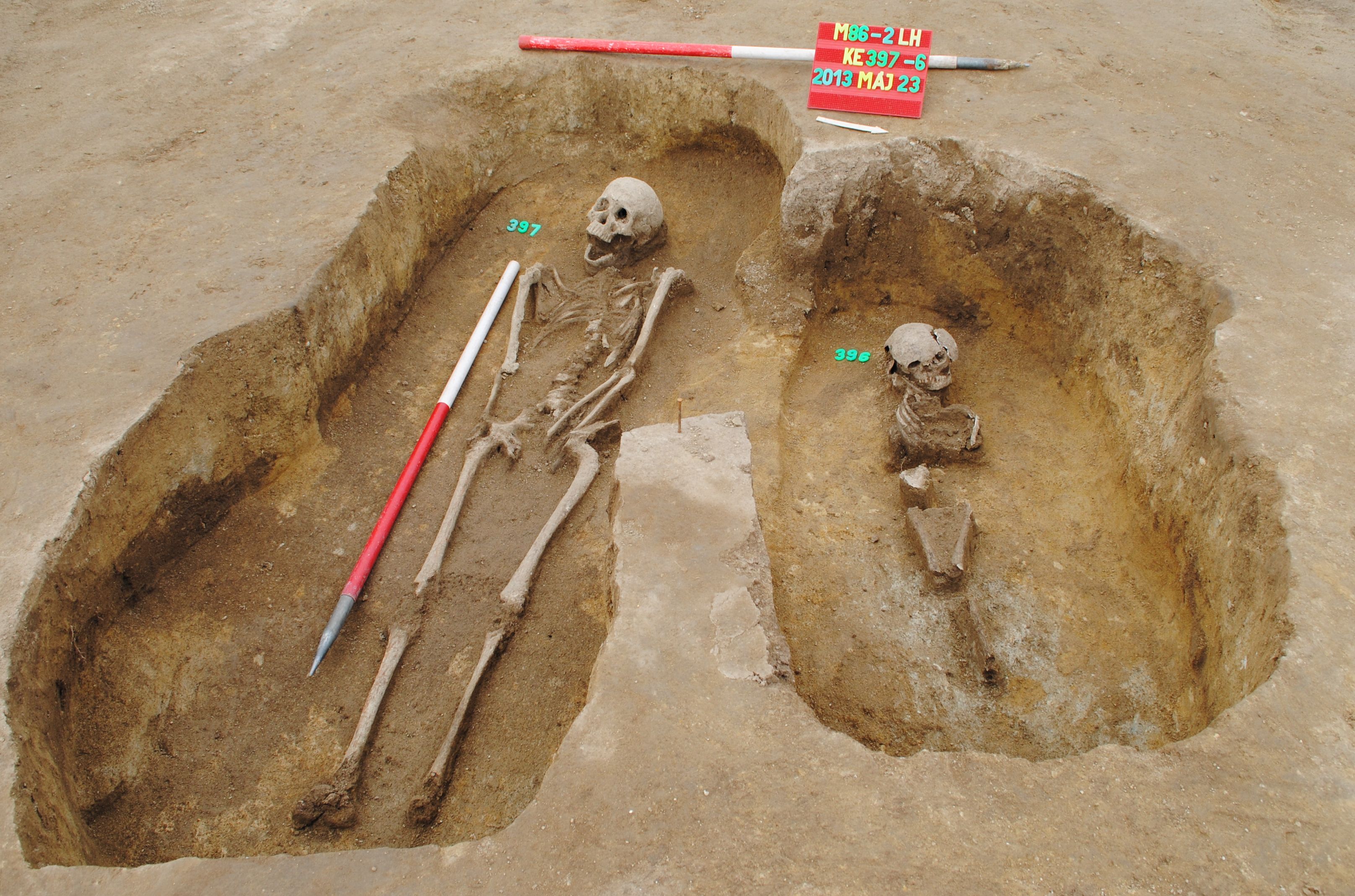 Burials of an adult and a child from the sixth-century cemetery at Szeleste, Hungary. Source: Savaria Museum, Szombathely, Hungary
The findings indicate that Roman-period populations were characterised by predominantly southern European genetic ancestry, with a notable presence of genetic diversity from Asia and Africa at the same time, representing the diverse, cosmopolitan nature of the Roman Empire, where people of different geographic and cultural backgrounds lived and moved together.
However, the post-Roman sites exhibited a rise in northern European genetic ancestry, most likely reflecting the population movements characteristic for the period. These newly arrived populations can likely be linked to the historically documented expansion of the Langobards (Lombards) into the region. In the 1st–2nd centuries CE, this northern Germanic people had appeared in what is now northern Germany, but at the end of the 5th century we already find them in the Middle Danube region, and the territories they ruled included the Little Hungarian Plain as well.
The evidence points to complex and long-term mobility patterns rather than a single large-scale migration event, with a continuous connection linking individuals in the Little Hungarian Plain to populations living farther north. These new communities did not just establish simple rural settlements but created a diverse, hierarchical society, in which the ruling elites played a decisive role in forging a new post-Roman polity.
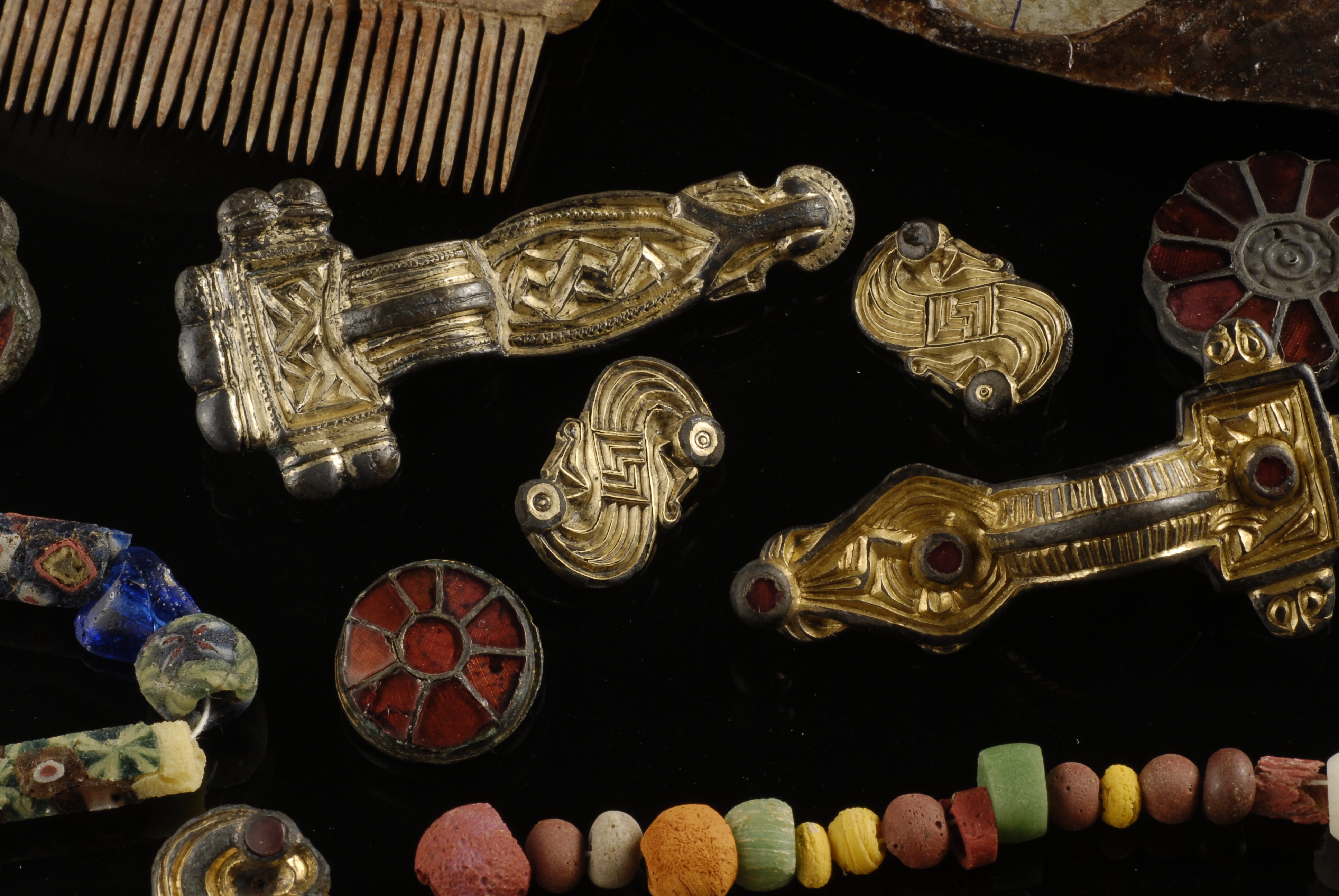 Collection of artefacts from the sixth-century cemetery at Szeleste, Hungary. Source: Savaria Museum, Szombathely, Hungary
The genetic and archaeological findings have also shown that the newly formed communities of this region were not homogeneous units in a biological sense: multiple modes of community formations were shaped by interactions between incoming groups with mainly northern European ancestry and surviving local populations with predominantly southern European ancestry, all helping to form a more complex society than previously surmised.
In the study, the colleagues of the Institute of Archaeogenomics, ELTE RCH were responsible for project management and laboratory tasks in the ERC HistoGenes workgroup. The collection and documentation of the bioarchaeological samples forming the basis of this study, the preparation of the isotope and DNA samples were conducted under the leadership of Anna Szécsényi-Nagy and Balázs Gusztáv Mende by the following current and former colleagues working in our laboratory: Koppány Kerestély, Daniella Pokker, Sára Gábriel, Viktória Oravecz and Viktória Bódis. We would like to take this opportunity to thank them once again for their dedicated work!
For more details about HistoGenes, visit the website of the project.
The original study:
Unveiling the complexity of post-Roman polity formation in Pannonia using ancient DNA, Science vol. 392, issue 680 (2026)
Press coverage
Stony Brook University News: Ancient DNA Study of Post-Roman Europeans Reveals the Emergence of a Complex New Society
Institute for Acvanced Study, News: Ancient DNA Study of Post-Roman Europeans Reveals the Emergence of a Complex New Society
Der Standard: Östlich des Neusiedler Sees entstand nach den Römern eine komplexe Population
Phys.org: Ancient DNA study of post-Roman Europeans reveals emergence of complex new society
Discover Magazine: 1,500-Year-Old DNA Shows How Migration, Mixing, and Kinship Shaped Post-Roman Pannonia
Archaeology News: Ancient DNA reveals how a complex new society emerged after the fall of the Roman Empire
Ancient Origins: Ancient DNA Reveals Complex Post-Roman Society in Pannonia
News.at: Völkerwanderung - Langobarden und Ex-"Römer" mischten sich in Ungarn
Vol.at: Mischung statt Verdrängung während der "Völkerwanderung"

